4.9 (30 Reviews)
Build pitch decks, financial models and gain the confidence to pitch your startup to real investors
Taught by Practitioners from











Founder, Fibonnaci X

Finance education for founders
This module covers the fundamentals of financial projections, growth assumptions, and linking business plans to financial models. Learn to map operational milestones to outcomes, plan scaling and capital needs, understand cap tables, equity dilution, ownership impact, and grasp valuation logic used by investors to assess company potential.
Introduction to fundraising
This module explains why startups raise capital and how funding supports growth, scaling, and product-market fit. Learn about investor types including angels, venture capital, strategic and corporate investors. Explore investment instruments such as equity, SAFE, convertible notes, debt, and grants, while understanding how to align your startup stage, sector, and growth potential with suitable investors.
Understanding when, why, and how much to raise
This module helps founders assess startup readiness by validating growth assumptions and understanding when to raise capital. Learn how early-stage and growth-stage fundraising differ, how much to raise using runway, burn rate, and milestone planning, and gain clarity on funding rounds from seed to Series A and beyond. It also explains investor due diligence across team, product, market, traction, and financial assumptions.
Finding & approaching the right investors
This module helps founders decode investor psychology by understanding risk tolerance, sector preferences, and key decision triggers. Learn how to build and prioritize a target investor list through research and contact mapping. Develop effective communication strategies, including strong outreach messages, follow-ups, and elevator pitches, using a clear, structured, and data-backed persuasion framework.
Decoding the pitch deck
This module explains why pitch decks matter and how they shape investor perception. Founders learn the core components of an effective deck, including problem, solution, market, traction, business model, competition, financials, and team. It focuses on high-level storytelling, preparing for investor questions, and ensuring GTM strategy and financials are clearly aligned within a persuasive narrative.
Demonstrating traction
This module helps founders clearly define their market by understanding segmentation, targeting, and positioning. Learn to build detailed buyer personas using research, identify the right acquisition and distribution channels, and plan effective media mixes for maximum ROI. It also introduces North Star Metrics and high-tempo testing frameworks to measure growth and drive repeatable, data-driven experimentation.
Pitch Simulation
Founders receive personalized inputs to strengthen pitch readiness and set clear fundraising goals. The module helps map milestones to financial outcomes, prepares founders for investor-style Q&A, and improves top-down storytelling so every part of the pitch remains aligned, logical, and easy for investors to follow.

Vishal Gupta
Co-founder

Pranshu Dwivedi
Ex - Executive director


Dr. Vibhuti Aggarwal
General partner


Shweta Agarwal
Co-founder


Amit Dharod
Managing Director


Ashish Nayyar
Ex Co-head & GCC advisor


Business plan
A validated thesis of market opportunity, scalability

GTM plan
A comprehensive Go To Market document tailored to your startup

Pitch deck
A narrative aligned with how VCs evaluate investments
Financial model
Clear projections, revenue assumptions, and cost structures
Investor access
At the end of the course you will pitch the idea to an investor panel
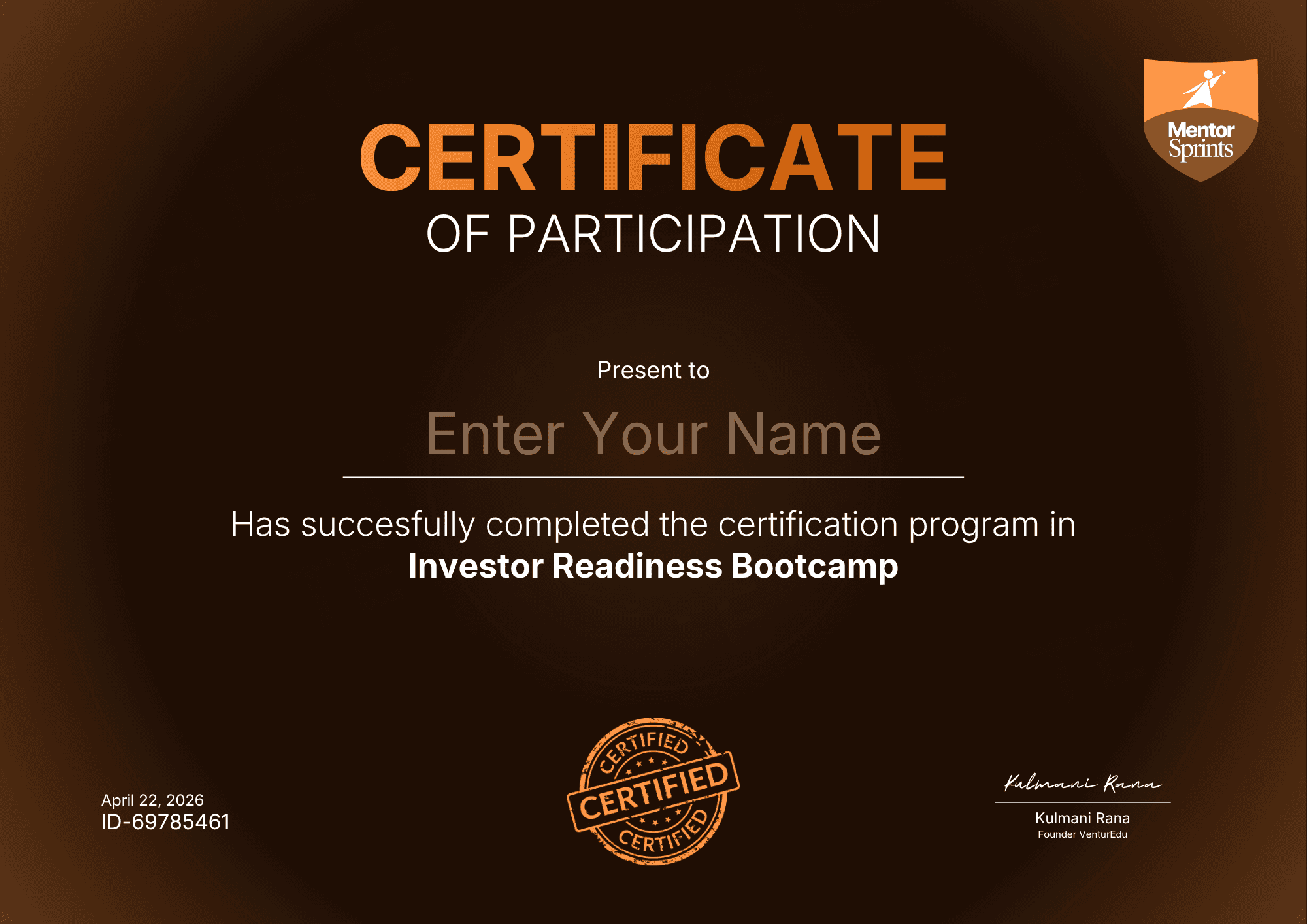
Digital certificate
Highlight investment understanding and gain credibility
Will this program fit into my full-time work or business schedule?
Yes. The bootcamp is designed specifically for working professionals and business operators. You’ll spend around 6 hours on weekends for in-person sessions and 4 hours on weekdays through live or recorded online modules.
Do I need a fully formed startup idea to join, or can I come with just a concept?
What kind of investors or mentors will I interact with during the bootcamp?
Does completing the program guarantee access to funding or introductions?


FAQ
Questions Institutes Ask Us Often
Who is this collaboration designed for?
Forward thinking universities looking to equip students with industry relevant skills in AI & Data Science, Finance, and Entrepreneurship
How will Mentor Sprints benefit our students?
How are the certification programs delivered?
Will these programs integrate with our existing curriculum?